Xinhua
12 Nov 2025, 14:45 GMT+10
China's partnerships with developing countries aim to make low-carbon growth both attainable and inclusive, demonstrating that climate progress and development can go hand in hand.
by Maya Majueran
As world leaders gather in the heart of the Amazon for the United Nations (UN) Climate Change Conference in 2025 (COP30), a quiet transformation is taking place. The global climate agenda is gradually moving from rhetoric to results -- from distant pledges to practical, affordable technologies that can make a real difference.
The air in Belem, Brazil is thick not just with humidity but with shifting power. The traditional architects of climate diplomacy -- the United States and Europe -- arrive weakened. Their credibility has eroded, their promises sound stale, and their leadership is now being challenged by a practical alternative from the Global South.
The West's case is fragile. The United States, the world's largest historical emitter, remains a political pendulum, its commitment to the Paris Agreement swinging with every election. The European Union, while projecting climate virtue, has fortified itself behind green trade barriers. Its Carbon Border Adjustment Mechanism (CBAM), hailed in Brussels as visionary, is viewed in Jakarta, Nairobi, and Brasilia as protectionism dressed in green. It penalizes emerging economies for industrializing, effectively pulling up the development ladder after they have climbed only several rungs on it.
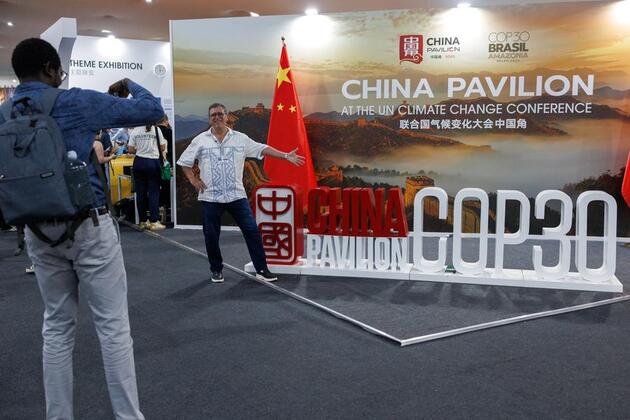
China, for its part, has been working to promote green cooperation and technology sharing. Guided by the vision of building a community with a shared future for humanity, it emphasizes sustainable industrialization. From solar panels to clean steel, China's partnerships with developing countries aim to make low-carbon growth both attainable and inclusive, demonstrating that climate progress and development can go hand in hand.
This approach is being realized through the green Belt and Road Initiative (BRI). In the United Arab Emirates, the Al Dhafra Solar PV Plant, built in partnership with China, stands among the world's largest, powering hundreds of thousands of homes. From Argentina's Cauchari solar parks to Kazakhstan's Zhanatas Wind Farm, Chinese technology is reshaping national grids.
For developing nations, cost is the decisive factor. A country that partners with China can often build renewable energy projects for a fraction of what Western-led financing would require. Chinese solar panels, turbines and transmission equipment are cheaper and come with fewer political strings attached.
By contrast, West-backed investment frameworks often tie funding to higher-cost technologies, lengthy approval processes, and restrictive conditions that make clean energy development prohibitively expensive. The result is a paradox: The nations most in need of affordable green power are pushed toward the costliest options, forced to choose between environmental responsibility and fiscal survival.
These projects partnering with China go beyond megawatts. They represent a model of partnership, one that trains local engineers, builds maintenance capacity and creates jobs. Green development becomes a lived reality, not a loan document. This stands in stark contrast to the conditional, slow-moving finance often offered by Western institutions, tied to politics and bureaucracy rather than urgency and need.
At the COP30, China's message is expected to be conveyed by delegations from countries whose hospitals now have reliable electricity, whose economies run on renewable power, and whose engineers are trained in green industries. Beijing is clearly a practical partner upholding multilateralism through action, in sharp contrast to the West's inconsistency and protectionism.
Globally, China's offer is coherent and compelling: technology transfer, affordable finance, and shared capacity. In a world tired of empty pledges, that message resonates.
The real test for the COP30 -- tellingly hosted in the Global South -- is whether the international community can move beyond geopolitical friction and embrace this new reality. The existing climate framework needs urgent strengthening, and it must be built on partnership, technology co-development and open supply chains.
If the West wants to reclaim its leadership, it must abandon the fortress mentality. It must replace protectionism with genuine cooperation, treating green technology as a shared global good, not a strategic weapon.
The most credible partner is not the one building walls but the one sharing technology.
Editor's note: Maya Majueran serves as the director of the Belt and Road Initiative Sri Lanka, an independent and pioneering organization with strong expertise in Belt and Road Initiative advice and support.
The views expressed in this article are those of the author and do not necessarily reflect those of Xinhua News Agency.
Get a daily dose of South America Times news through our daily email, its complimentary and keeps you fully up to date with world and business news as well.
Publish news of your business, community or sports group, personnel appointments, major event and more by submitting a news release to South America Times.
More InformationNEW DELHI, India: An explosion in a car near Delhi's historic Red Fort on November 10 killed nine people and injured at least 20 others,...
WASHINGTON, D.C.: President Donald Trump has granted pardons to Rudy Giuliani, Sidney Powell, and several other allies accused of trying...
NEW DELHI, India: A dense grey haze blanketed New Delhi on November 10, choking the city's skyline and sending pollution levels soaring...
DUBAI, U.A.E.: U.S. President Donald Trump has been promoting the idea of Saudi Arabia normalizing relations with Israel, but such...
LONDON, U.K.: The BBC's top two executives — Director-General Tim Davie and News CEO Deborah Turness — resigned on November 9 amid...
WASHINGTON, D.C.: The U.S. Senate on November 9 took a significant step toward ending the federal government shutdown, now in its 41st...
New Delhi [India], November 13 (ANI): Argentina's Ambassador to India Mariano Caucino conveyed a message of condemnation over the terrorist...
(Photo credit: Angelina Alcantar/News Sentinel / USA TODAY NETWORK via Imagn Images) Tennessee's up-and-down 2025 football season...
(Photo credit: Jeff Romance-Imagn Images) NFL history will be made Sunday when Washington and Miami play the league's first ever...
(251112) -- MEXICO CITY, Nov. 12, 2025 (Xinhua) -- This aerial drone photo taken on Nov. 12, 2025 shows a vaccination center in Mexico...
New Delhi [India], November 13 (ANI): The Ambassadors of Switzerland and Argentina expressed condolences and said that they stand with...
Washington, DC [US], November 13 (ANI): Director of the Federal Bureau of Investigation Kash Patel on Wednesday (US local time) made...